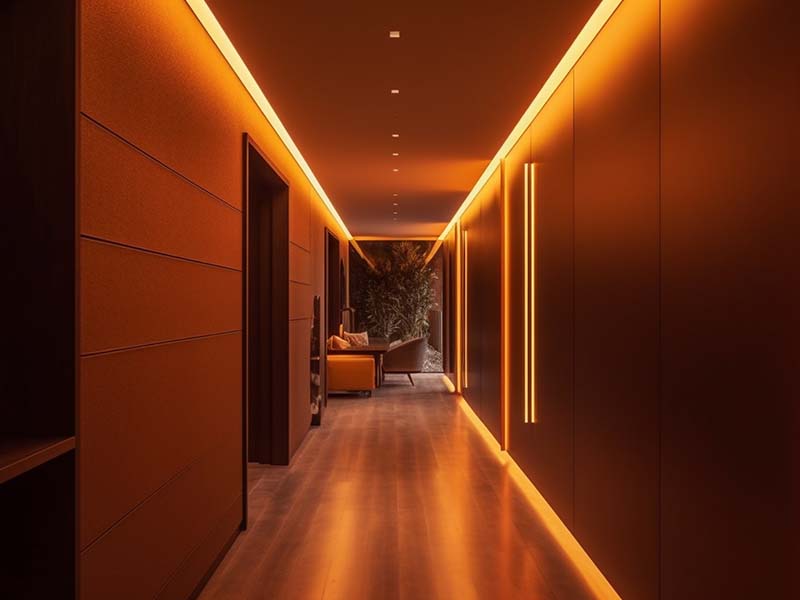

COB LED strip is flexible lighting tape that uses chip-on-board construction to place closely arranged LED chips along a circuit. In common white-light versions, the light-emitting layer gives the strip a continuous-looking appearance rather than the clearly separated packages seen on many conventional strips.
COB describes construction. It does not specify voltage, brightness, color quality, waterproofing or control compatibility. Those properties must be checked for the actual strip model.
What COB means
COB stands for chip on board. The underlying distinction is how the LED chips are incorporated into the assembly, compared with mounting individually packaged devices. The term is used for several kinds of LED products, not just flexible tape. Tridonic explanation of LED construction
A compact COB light engine used in a spotlight and a reel of COB tape are therefore not the same product. They can have different electrical requirements, mechanical construction and mounting arrangements. Do not select a driver from the word COB alone.
For a buyer encountering the term for the first time, the most useful next step is to obtain the strip’s datasheet. It should identify the exact product and the requirements for operating and installing it.
Why COB tape can look like a continuous line
The closely arranged light sources and coating in common COB tape reduce the obvious separation between emitting points. Manufacturer introductions describe this as a smoother or more continuous appearance. AVSL guide to LED tape
The appearance is useful when people view the lighting detail at close range, but it should not be treated as a guarantee of perfect continuity everywhere. Joints, end caps, reflections, mounting geometry and viewing angle can still affect what the observer sees.
A diffuser may still be appropriate for protection or the desired light distribution, even when individual dots are difficult to distinguish. Approve the complete assembly, not only an illuminated sample held in the air.
Read the strip specification beyond the word COB
Voltage and power
Find the specified supply voltage and operating mode. A low-voltage COB strip designed for constant-voltage input needs that compatible output. It should not be connected to a constant-current driver simply because another COB product uses one.
Record watts per meter and the permitted feed arrangement. Total reel length is a packaging quantity, not automatically the maximum run that may be connected from a single feed. For driver planning, use the LED strip power supply guide. If the terminology is unclear, read LED driver vs power supply.
Color and control type
A COB product can be single-color or use a more complex color arrangement. Ask whether the selected strip is fixed white, tunable white, RGB, RGBW or addressable, and confirm the intended controller. A continuous-looking surface does not tell you which effects it supports.
For white lighting, specify color temperature and color-quality requirements separately. For adjustable or colored lighting, specify the operating behavior the project needs. This prevents an enquiry for “COB strip” from producing several quotations for materially different products.
Dimensions and environmental suitability
Check the strip width and thickness against the profile, including space for connectors. Confirm the cutting increment, permitted bending direction and mounting method. Do not assume the tape can bend sharply sideways because it is flexible along its length.
Environmental suitability also needs a separate specification. For example, Signify’s COB family leaflet identifies an IP20 product alongside its continuous-line description. The COB construction itself is not evidence of waterproofing. Signify COB strip family leaflet
Where COB strip can be useful
Consider COB tape for details where the visible light line or its reflection is important. Possible project types include shelving, furniture details, display fixtures and architectural lines inside suitable profiles. These are application directions to evaluate, not a claim that every COB strip is suitable for every location.
For retail displays, inspect the appearance of the merchandise under the sample. For a cabinet detail, check glare from seated and standing positions. For a corridor line, inspect joints and the longest visible stretch. Each context gives the sample review a different purpose.
If the installation is deeply concealed, a conventional SMD strip may also meet the brief. Our COB vs SMD LED strip comparison explains how to compare both without assuming one is always superior.
Installation details to plan early
Identify the cut points before matching a strip to a finished dimension. Allow for end connections and access to the supply. Confirm any thermal mounting requirements in the product instructions; a continuous coating does not establish that heat management is unnecessary.
Choose connectors for the actual pad arrangement and surface construction. Do not force a clip intended for another tape onto the coating or LED area. If field cutting is permitted on a protected product, use the specified termination and resealing process.
Test the intended assembly before a volume order or permanent fit-out. Use a properly selected power source and controls, and follow the manufacturer’s testing instructions. Do not operate a tightly wound reel as a demonstration.
A first-sample checklist
Ask for a sample identified by model number and supplied with matching documentation. Then use a record like this:
| Check | Evidence or observation to retain |
|---|---|
| Product identity | Model number and datasheet revision |
| Electrical match | Voltage, power rating and intended supply |
| Mechanical fit | Profile fit, connector clearance and cut length |
| Visual result | Appearance from the actual viewing positions |
| Color | Agreed color temperature and model-specific color data |
| Controls | Required channels and tested operating modes |
| Installation | Mounting and termination instructions |
| Future supply | Agreed identification and matching requirements for repeat orders |
Do not substitute the sample’s visual appeal for missing electrical information. The sample and documents serve different purposes and should be reviewed together.
Frequently asked questions
What does COB stand for?
Chip on board. In flexible LED tape, it describes the construction used to incorporate the closely arranged LED chips.
Are COB LED strips dimmable?
Some are, with compatible equipment. Confirm the actual product specification and control arrangement rather than inferring dimming capability from the COB name.
Can COB strip be cut anywhere?
No. Use only the permitted cut points and instructions for the selected model. Some products may have additional restrictions on field modification.
Does the coating make COB strip waterproof?
Not by itself. Verify the exact product’s environmental rating and the requirements for connectors and cut ends.
Explore the right COB strip format
Browse TTLL’s COB LED strip range and send your application details, including length, profile space, desired light appearance and controls. A specific brief makes it easier to discuss a suitable sample rather than selecting by the COB label alone.