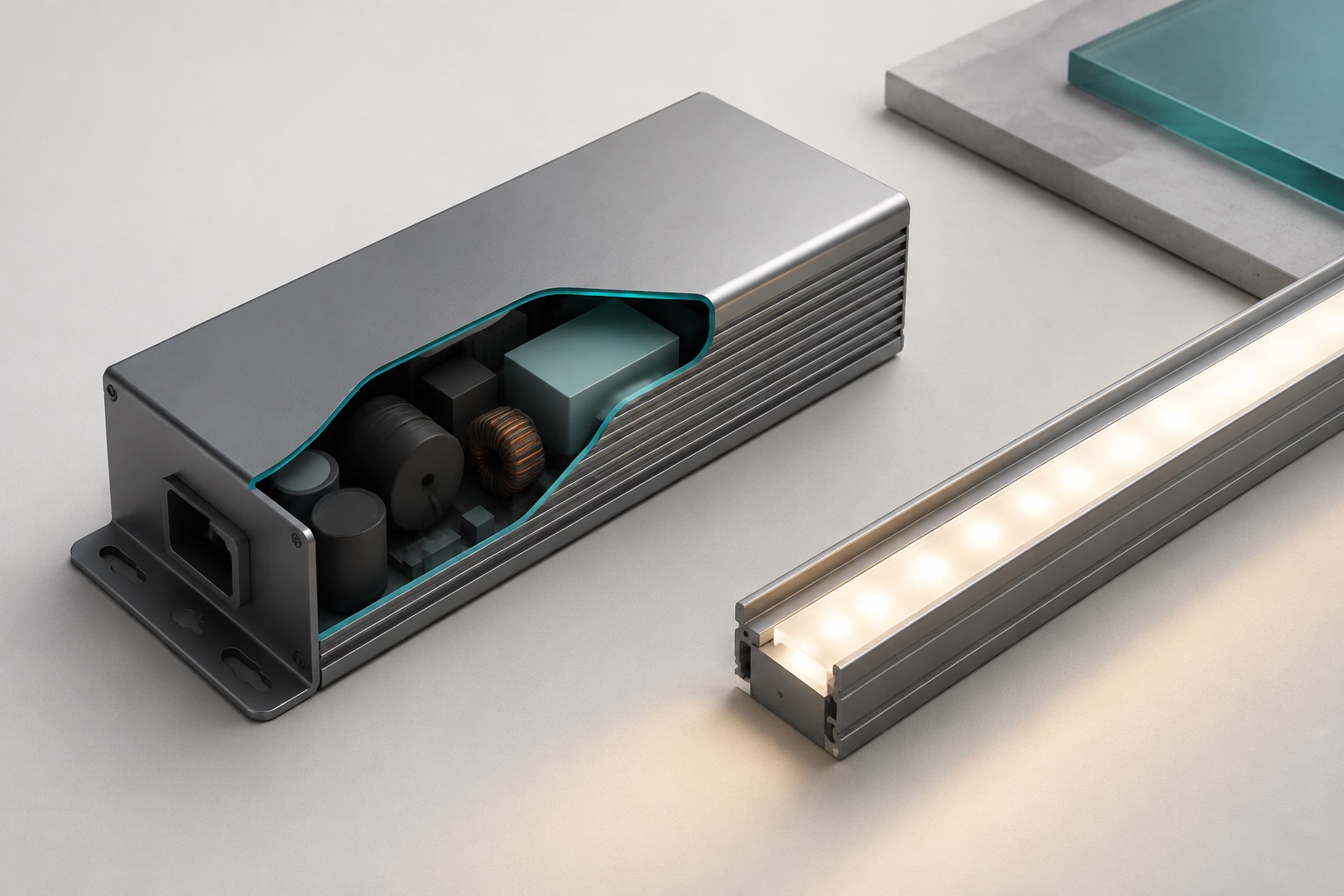
An LED power supply is a device that provides the electrical output an LED lighting system requires. In a typical low-voltage strip installation, it converts AC input into regulated DC output. The LED load determines whether that output must hold a specified voltage or regulate a specified current.
You may also see the terms LED driver, adapter or transformer in product descriptions. To understand what a device actually does, read its input and output specifications rather than relying on its name.
What the power supply does in a lighting system
Think of a strip installation as several connected functions. The building provides electrical power. The supply delivers an output appropriate for the lighting load. A controller, where needed, determines brightness or color. The strip produces light.
Some products combine more than one function, while others use separate devices. A compact plug-in adapter and a larger enclosed supply may both provide constant-voltage DC output, despite looking quite different.
Manufacturer literature describes LED power supplies with constant-voltage, constant-current and controllable output arrangements. There is no single electrical architecture implied by the words “LED power supply.” MEAN WELL LED power supply overview
For a buyer, the key task is to identify the required input, the required output and any control function the system expects. If those three points are missing from an enquiry, a supplier may quote a product that has the right wattage but the wrong function.
What it does not do
A power supply does not, by itself, establish the brightness or color quality of a strip. Those depend on the light source and the complete system. It also does not automatically provide RGB control, resolve a long cable’s voltage drop or make an installation suitable for outdoor exposure.
Nor does an output rating authorize arbitrary connections. Cables, connectors and controllers need their own appropriate ratings. A system with a 200W supply may still contain a connector that cannot carry the current of a particular branch.
These distinctions help keep product requests precise. “We need a supply for a 24V RGBW strip” is a start, but the controller, connected load and installation details still need to be specified.
How to read an LED power supply label
Read input and output as separate sections. An AC input range tells you about the source feeding the unit. A DC output rating tells you about the circuit feeding the strip. Do not use the input current rating as the available strip current.
A fictional label explained
The following values illustrate label reading. They do not describe a TTLL model.
| Example field | How to interpret it |
|---|---|
| Input: 100–240V AC, 50/60Hz | The stated input range and frequency; installation must follow the actual manual |
| Output: 24V DC | The nominal output voltage for a compatible load |
| Output current: 4A maximum | The stated output current capacity under the documented conditions |
| Rated output: 96W | 24V × 4A; this is output capacity, not a promise of constant consumption |
| Model number | The identifier needed to retrieve the correct documentation |
The label may not contain the complete specification. Ask for the datasheet to check permitted operating conditions, protection behavior, control compatibility and installation requirements. If a label is illegible, do not use its enclosure shape to identify a replacement.
Constant voltage and constant current in plain English
A constant-voltage supply is designed to maintain a specified output voltage within its operating limits. The compatible connected load draws current according to its behavior. Many low-voltage strips are designed for this arrangement and include circuitry appropriate to the specified supply voltage.
A constant-current driver regulates output current and operates within a specified output-voltage range. A compatible LED module must match both the current requirement and the operating window. Manufacturer descriptions distinguish these operating modes explicitly. MEAN WELL explanation of LED drive methods
The practical lesson is to copy the load’s electrical requirements into the specification. Do not choose between the two modes by enclosure size, strip appearance or wattage alone. Our LED driver vs power supply guide includes replacement examples.
Common physical formats
Product photographs can help with space planning, but they are not electrical compatibility evidence. Common formats include plug-in adapters, enclosed units intended for wired installation and protected housings for specified environments.
A plug-in assembly may simplify a compatible small installation, but its connector dimensions and polarity still matter. A wired unit needs its documented mounting and connection provisions. An enclosed or sealed appearance does not reveal whether a device is appropriate for the proposed exposure or temperature.
For commercial interiors, also ask how the unit will be reached after fit-out. A compact driver that fits into a recess is not necessarily a good choice if inspection or replacement requires removing permanent finishes.
Questions to ask when a specification is incomplete
Before requesting a price, collect the strip or module model number and the information below. If you are replacing a failed unit, include readable photographs of its label and the load’s label, with the system isolated before inspection.
- What input supply is available at the project location?
- What output mode and voltage or current does the load require?
- What is the total connected load at its specified maximum operating condition?
- Is dimming or color control required, and through which devices?
- Where will the unit be installed, and how will it be serviced?
- Which model-specific documents does the project require?
For the subsequent selection process, use the LED strip power supply guide. It turns these answers into a specification checklist.
Frequently asked questions
Is an LED power supply the same as a transformer?
A transformer is one type of electrical component. The term is sometimes used loosely for an LED power unit, but the required output may also involve conversion and regulation. Purchase against the actual specification, not the informal name.
Do LED strips connect directly to mains electricity?
Low-voltage DC strips do not. They require the specified compatible power arrangement. Products designed for higher-voltage systems are a separate category with their own instructions; this article is not a connection guide for them.
Does a 100W supply always consume 100W?
No. Rated output is capacity. Actual input power depends on the connected load, conversion efficiency and operating state, including standby behavior where relevant.
Is a power supply also an RGB controller?
Not necessarily. A controller handles the required color channels; some systems integrate functions, but many use a separate supply and controller. Check the system diagram.
Find the next step for your lighting system
Browse TTLL’s LED power supply categories to see the available product directions. If you are unsure which output type your project needs, send the load specification and proposed layout as the basis for an enquiry.