
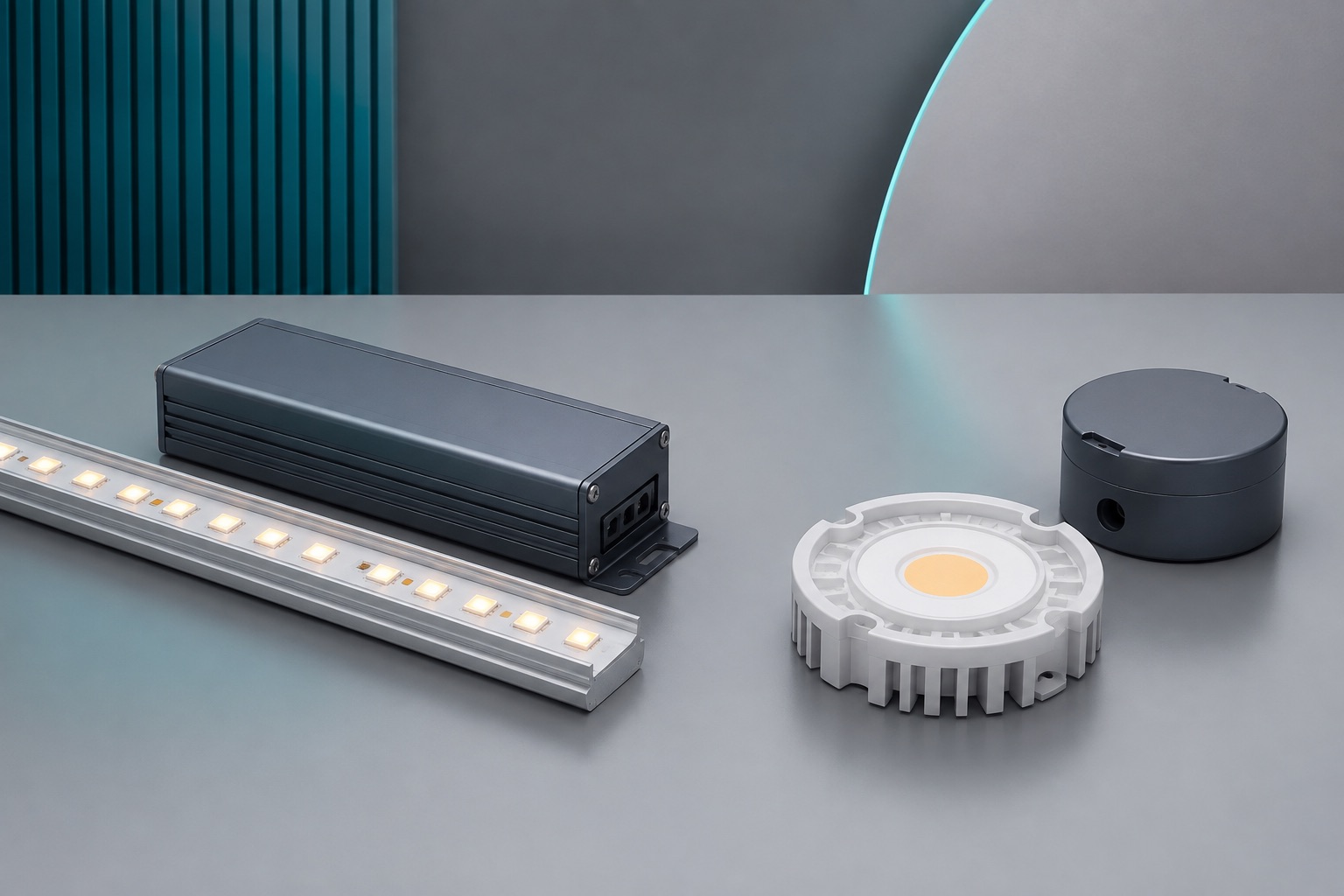
An LED driver and an LED power supply are not necessarily different devices. Lighting suppliers often use the terms for overlapping product categories. The important distinction is the actual output: constant voltage, constant current, or a documented combination of operating modes.
For replacement or specification, match the load’s electrical requirements first. A product called a “driver” can supply constant-voltage LED tape, while a unit advertised as an “LED power supply” may regulate current for a module. The name alone cannot establish compatibility.
Why the names overlap
“Power supply” describes the power-delivery function. “LED driver” identifies equipment intended to operate an LED load and may refer to a complete AC-input unit or a driver stage within a larger system. Product descriptions are not consistent enough to use these labels as a technical selection rule.
MEAN WELL’s documentation describes both constant-voltage and constant-current operation, including products with CV and CC regions. This is why the rule “drivers are always constant current” is unreliable. MEAN WELL LED technical FAQ
If you first need to understand the label fields, read what an LED power supply is. The comparison below focuses on output matching and replacement decisions.
Constant voltage versus constant current
| Check | Constant-voltage system | Constant-current system |
|---|---|---|
| Regulated quantity | Output voltage | Output current |
| Starting point | Load’s specified DC voltage | Load’s specified drive current |
| Additional output check | Current and power capacity under the installation conditions | LED forward-voltage range inside the driver’s operating window |
| Common application | Strip or module designed for a fixed supply voltage | LED assembly designed for a specified drive current |
| Replacement mistake | Choosing the wrong voltage because the watts match | Choosing the wrong current because the watts match |
This table describes operating modes, not the appearance of the product. Both require correct input, controls, protection and installation suitability.
Three examples of compatible and incompatible replacements
The examples below use fictional values to show the decision process. They are not model recommendations.
A 24V constant-voltage strip
Suppose a strip assembly is specified for 24V DC and its calculated load is 72W. Its corresponding output current is 72 ÷ 24 = 3A. A candidate supply needs the correct constant-voltage output and adequate usable capacity, including the project’s margin and installation conditions.
A 24V unit with greater available current may be appropriate after the remaining compatibility checks. A 12V unit is not an equivalent replacement, even if its wattage is higher. A driver labeled 700mA with a variable voltage window is also not an equivalent 24V strip supply.
An LED module with a specified drive current
Now consider a module specified for 700mA, with a documented operating forward-voltage range of 30–36V. A candidate driver must provide the required current and support that voltage range, including relevant tolerances and operating conditions.
A fictional 700mA driver with a 24–42V operating window may be a candidate. Its full datasheet must still be checked. A 1,050mA driver is not a like-for-like replacement merely because its maximum wattage looks suitable. Likewise, a driver whose operating window ends at 32V would not cover the stated upper requirement.
Manufacturer guidance specifically requires the LED voltage range to fit within the selected driver’s constant-current region. MEAN WELL driver selection FAQ
A driver labeled CV + CC
A combined label means the operating curve needs examination. Determine which region the proposed load will use, whether settings are adjustable and what limits apply. Do not assume the unit can replace any fixed-voltage supply or current driver simply because both abbreviations appear on the datasheet.
For an existing installation, provide the original model and settings to the supplier. If settings cannot be established, resolve that uncertainty before connecting a replacement.
Dimming does not determine the output type
The words “dimmable,” “DALI” or “0–10V” describe control-related capabilities; they do not by themselves tell you whether the load requires CV or CC output. Record the output requirement and the control requirement as separate fields.
For a replacement, identify the exact control equipment, wiring arrangement and required behavior. A supply may match the load at full output yet behave differently during dimming, startup or switching. Request compatibility information and test the proposed combination at the intended operating points.
Avoid solving an output mismatch by adding an unspecified controller. Any additional stage needs its own input and output ratings and a documented role in the system.
Replacement compatibility checklist
Photograph the old label and obtain the load specification. Then ask the supplier to complete a comparison, rather than approving a replacement from an online product title.
| Item | Record for original and candidate |
|---|---|
| Input | Voltage range, frequency and installation arrangement |
| Output | CV voltage or CC current and voltage window |
| Usable capacity | Limits under the actual operating conditions |
| Controls | Required interface and documented compatibility |
| Mechanical fit | Dimensions, mounting points and connection space |
| Environment | Temperature, exposure and enclosure requirements |
| Documentation | Exact model datasheet and project-required evidence |
Mark each field as matched, different or unresolved. A physically similar unit with unresolved output behavior should remain a candidate, not an approved substitute.
For a new strip project, the power supply selection guide covers the wider system-planning process.
Frequently asked questions
Are all LED drivers constant current?
No. Driver terminology includes constant-voltage products. Check the output specification and operating curve.
Can I replace a driver with a higher-wattage unit?
Possibly, but wattage is only one check. Keep the required CV voltage or CC current, verify the operating window where relevant, and check control and installation compatibility.
Does COB always require constant current?
No. A COB module and a flexible COB strip can have different electrical designs. Read the load specification. Our COB strip introduction explains that distinction.
Can a generic DC supply operate an LED strip?
Only if it meets the strip’s electrical requirements and the complete installation requirements. A matching voltage printed on a generic adapter does not establish every other required property.
Request a match using the original specifications
Use TTLL’s LED driver power supply page as a starting point. Send the original and load specifications, including the control method and installation environment, so the replacement discussion is based on operating requirements.